what caused britain to enter world war i in 1914
Daily Mail service on Aug v. 1914
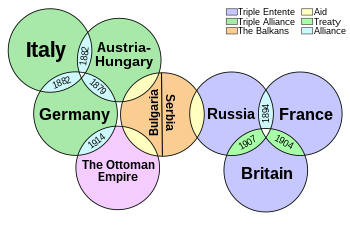
European diplomatic alignments shortly before the war.
Cracking Britain entered World State of war I on iv Baronial 1914 when the King declared state of war afterwards the expiration of an ultimatum to Frg. The official caption focused on protecting Belgium equally a neutral state; the main reason, however, was to preclude a French defeat that would have left Germany in control of Western Europe. The Liberal Party was in power with prime minister H. H. Asquith and foreign minister Edward Grey leading the way. The Liberal cabinet made the decision, although the party had been strongly anti-war until the final minute. The Conservative Party was pro-state of war. The Liberals knew that if they split on the state of war issue, they would lose command of the authorities to the Conservatives.
Groundwork [edit]
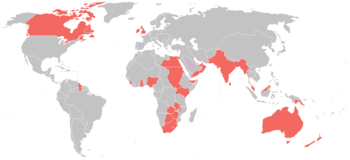
The British Empire in 1914
For much of the 19th century, Uk pursued a policy afterward known equally splendid isolation, which sought to maintain the balance of ability in Europe without formal alliances. As Europe divided into ii ability blocs during the 1890s, the 1895-1905 Conservative government realised this left U.k. dangerously exposed.[1] This resulted in the 1902 Anglo-Japanese Alliance, followed by Rex Edward VII'southward 1903 visit to Paris. By reducing anti-British feeling in France, it led to the 1904 Entente Cordiale, the outset tangible touch on of which was British back up for France against Germany in the 1905 Moroccan Crisis.
In 1907, the new Liberal regime agreed to the Anglo-Russian Convention. Like the Entente, the Convention focused on resolving colonial disputes; merely past doing so, it paved the way for wider co-operation and allowed Britain to refocus its naval resources in response to German naval expansion.[two]

The 1911 Agadir Crisis encouraged clandestine military negotiations between France and Britain in the case of war with Germany. A British Expeditionary Strength of 100,000 men would be landed in France inside two weeks of war, while naval arrangements allocated responsibility for the Mediterranean to France, with the Royal Navy looking after the Northward Sea and the English language Aqueduct, including Northern French republic.[three] Great britain was effectively bound to back up France in a war against Germany regardless, merely this was not widely understood outside authorities and the military.
Antagonism with Germany [edit]
In explaining why Britain went to war with Germany, British historian Paul Kennedy (1980) argued that a disquisitional factor was the British realisation that Deutschland was rapidly becoming economically more powerful than U.k.. It was in essence not a consequence of the disputes over economic trade imperialism, the Baghdad Railway, the confrontations in Eastern Europe, highly-charged political rhetoric, or domestic pressure level groups. Germany's reliance time and again on military assailment, while Britain increasingly appealed to moral sensibilities, as well played a office, particularly in portraying the invasion of neutral Belgium as (in the German view) a necessary military tactic or (in the British view) a profound moral law-breaking. The German language invasion of Kingdom of belgium was not the real cause of state of war with Uk, considering the British decision had already been made as the British were more concerned with the fate of France (pp. 457–62)[ clarification needed ]. Kennedy argues that by far the main reason was London'south fear that a repeat of the war of 1870, when Prussia and the German language states smashed France, would mean that a rapidly industrialising Federal republic of germany, with a powerful army and navy, would control the English Aqueduct and northwest France. British policy-makers insisted that that would be a ending for British security.[iv]
Christopher Clark points out that the British cabinet decided on July 29, 1914, that being a signatory to the 1839 treaty guaranteeing Kingdom of belgium'southward frontiers did not obligate it to oppose a German invasion of Belgium with military force.[five]
Conclusion for state of war [edit]
In the firsthand aftermath of the bump-off on June 28 of Austrian Archduke Franz Ferdinand (the heir to the Habsburg throne) in the Bosnian capital, Sarajevo, the British newspapers denounced the Serbian assassin, Gavrilo Princip, and were generally sympathetic to the Austro-Hungarian monarchy. The newspapers blamed Serbia for the crime, with rhetoric confronting "fanatics", "dangerous forces" and "reckless agitators". These responses were broadly shared across the political spectrum, with Liberal and Conservative papers expressing their shock and dismay. Only by July 27, press opinion had turned confronting Austria-hungary. The national press divided along party lines, with Conservative papers stressing the obligation to back up France, while Liberal papers insisted United kingdom had no such commitment and should remain neutral. [vi] [7]
As Federal republic of germany and Russia became the central players in the crisis (respectively backing Austria-Republic of hungary and Serbia), British leaders increasingly had a sense of delivery to defending French republic. First, if Germany over again conquered France, equally had happened in the Franco-Prussian State of war of 1870, it would become a major threat to British economic, political and cultural interests. 2nd, partisanship was involved. The Liberal Party was identified with internationalism and complimentary trade, and with opposition to jingoism and warfare. By contrast, the Conservative Party was identified every bit the party of nationalism and patriotism; Britons expected information technology "to testify capacity in running a war."[8] Liberal voters initially demanded peace, simply were outraged when the Germans treated Belgian neutrality equally a worthless "scrap of paper" (the words of the German chancellor in ridiculing the Treaty of London (1839)). Federal republic of germany, as office of a massive attack on French republic, invaded northern France through Kingdom of belgium early on the morning of iv August. The Belgians called upon Britain for armed services assist nether the 1839 treaty, and in response London gave Berlin an ultimatum which expired at 11 pm London time, which was ignored. The king then declared state of war on Frg that evening.[9] [10]
Earlier war was declared, the British newspapers gave the crisis extensive coverage only varied wildly in recommended policy options, basically covering the entire spectrum from peace to state of war.[11] [12] C. P. Scott and the Manchester Guardian maintained an intense campaign against war. It denounced a "conspiracy to drag the states into a war confronting England's interests", arguing that information technology would amount to a "criminal offense against Europe", and warning that it would "throw away the accumulated progress of half a century".[13] The politician David Lloyd George told Scott on Tuesday quaternary August 1914, "Upwards until last Lord's day only 2 members of the Cabinet had been in favour of our intervention in the state of war, but the violation of Belgian territory had completely altered the situation".[13] According to Isabel Five. Hull:
- Annika Mombauer correctly sums up the current historiography: "Few historians would yet maintain that the 'rape of Belgium' was the real motive for Britain's proclamation of state of war on Germany." Instead, the office of Belgian neutrality is variously interpreted as an excuse used to mobilise public stance, to provide embarrassed radicals in the cabinet with the justification for abandoning the principal of pacifism and thus staying in office, or - in the more conspiratorial versions - as encompass for naked imperial interests. [14]
Once war was declared, defense force of Kingdom of belgium rather than France was the public reason given for the war. Propaganda posters emphasised that United kingdom was required to safeguard Belgium'south neutrality nether the 1839 Treaty of London.[15] [16]

"The Scrap of Newspaper - Enlist Today", 1914 British propaganda poster emphasizes German contempt for the 1839 treaty (the signature of British Strange Secretarial assistant Lord Palmerston visible at the top), which guaranteed Belgian neutrality, as merely a "scrap of newspaper" that Frg would ignore.
Every bit belatedly as 1 Baronial 1914, the great majority of Liberals—both voters and chiffonier members—strongly opposed going to war.[17] The German invasion of Belgium was such an outrageous violation of international rights that the Liberal Political party agreed for war on August 4th. Historian Zara Steiner says:
- The public mood did change. Belgium proved to be a catalyst which unleashed the many emotions, rationalizations, and glorifications of state of war which had long been part of the British climate of opinion. Having a moral cause, all the latent anti-German language feelings, fueled by years of naval rivalry and assumed enmity, rose to the surface. The 'scrap of paper' proved decisive both in maintaining the unity of the regime and and then in providing a focal point for public feeling.[xviii]
The Liberals succeeded in mending their deep divisions over military activity. Unless the Liberal government acted decisively against the German invasion of France, its superlative leaders including Prime Government minister H. H. Asquith, Strange Minister Edward Grayness, First Lord of the Admiralty Winston Churchill and others would resign, leading to a risk that the much more than pro-war Conservative Party might grade a government. Mistreatment of Kingdom of belgium was non itself a central cause of British entry into the war, only it was used extensively equally a justification in wartime propaganda to motivate the British people.[xix]
The German language high command was enlightened that inbound Belgium could trigger British intervention but decided the risk was adequate; they expected it to be a brusk war, and their ambassador in London claimed civil war in Ireland would prevent Britain from assisting French republic.[twenty]
Historians looking at the July crisis typically conclude that Gray:
- was not a great Foreign Secretary but an honest, reticent, punctilious English gentleman... He exhibited a judicious understanding of European affairs, a firm control of his staff, and a suppleness and tact in affairs, but he had no boldness, no imagination, no ability to command men and events. [Regarding the war] He pursued a cautious, moderate policy, one that not simply fitted his temperament, but also reflected the deep split in the Cabinet, in the Liberal party, and in public opinion.[21]

Canada automatically joined the war, and vigorously recruited volunteers.
Irish gaelic crisis on concur [edit]
Until tardily July, British politics was totally focused on the threat of civil war in Ireland. In 1912 the regime had presented a Domicile Rule bill that Irish nationalists demanded; under the terms of the Parliament Act 1911, by which the Business firm of Lords retained the right to filibuster legislation by upwards to two years, it was due to go police force in 1914. The Ulster Protestants demanded dissever treatment; past 1914 the government was offering a six-year opt-out to the half-dozen counties which would eventually become Northern Ireland, but not the permanent exemption which they demanded. Both sides in Ireland had smuggled in weapons, set militias with tens of thousands of volunteers, were drilling, and were ready to fight a civil war. The British Army itself was paralyzed: during the Curragh Incident officers threatened to resign or accept dismissal rather than obey orders to deploy into Ulster. Elements of the Unionist (Conservative) Political party supported them. On 25 July the Austrian ultimatum to Serbia became known, and the cabinet realized that war with Germany was increasingly likely. The Regime of Ireland Human activity 1914 was enacted into constabulary, simply was suspended for the duration of hostilities, with the effect of Ulster notwithstanding unresolved.[22] Gray told Parliament on 3 Baronial, "The one bright spot in the whole of this terrible situation is Republic of ireland. [Prolonged cheers.] The general feeling throughout Ireland, and I would like this to be conspicuously understood abroad, does non make that a consideration that we feel we have to take into account. [Cheers.]"[23]
Empire at war [edit]
The rex's announcement of war automatically involved all dominions and colonies and protectorates of the British Empire, many of whom made significant contributions to the Centrolineal war endeavor, both in the provision of troops and civilian labourers.
See also [edit]
- Causes of World State of war I
- Austro-Hungarian entry into World War I
- French entry into World War I
- German entry into Globe War I
- Ottoman entry into World War I
- Russian entry into Globe War I
- Allies of World War I
- Triple Entente
- France–United Kingdom relations
- Germany–Great britain relations
- British military history
- History of the United Kingdom, since 1707
- International relations of the Not bad Powers (1814–1919)
- Diplomatic history of World State of war I
- Color book
- International relations (1919–1939)
- Timeline of British diplomatic history
- History of the strange relations of the United Kingdom
Notes [edit]
- ^ Avner Cohen, "Joseph Chamberlain, Lord Lansdowne and British foreign policy 1901–1903: From collaboration to confrontation." Australian Journal of Politics & History 43#2 (1997): 122-134.
- ^ Massie, Robert (2007). Dreadnought: Britain, Federal republic of germany, and the Coming of the Great War (2013 ed.). Vintage. pp. 466–468. ISBN978-0099524021.
- ^ Jenkins, Roy (1964). Asquith (1988 Revised and Updated ed.). Harpers Collins. pp. 242–245. ISBN978-0002173582.
- ^ Kennedy, Paul 1000 (1980). The rising of the anglo-german animosity: 1860-1914 . London: Allen & Unwin. pp. 464–70. ISBN9780049400641.
- ^ Christopher Clark, The Sleepwalkers (2012) p. 539.
- ^ Meilyr Powel, "The Welsh press and the July Crunch of 1914." First Globe War Studies 8.two-three (2017): 133-152.online
- ^ Adam James Basic, "British National Dailies and the Outbreak of State of war in 1914." International History Review 35.5 (2013): 975-992.
- ^ Trevor Wilson, The Downfall of the Liberal Political party 1914-1935 (1966) p 51.
- ^ Nilesh, Preeta (2014). "Belgian Neutrality and the First world State of war; Some Insights". Proceedings of the Indian History Congress. 75: 1014. JSTOR 44158486.
- ^ Adrian Gregory, "A Disharmonism of Cultures: The British Press and the Opening of the Smashing War," in A Call to Arms: Propaganda, Public Opinion, and Newspapers in the Smashing War, edited by Troy R. E. Paddock, (Praeger, 2004) pp 15–49.
- ^ Hale, Publicity and Affairs: With Special Reference to England and Germany, 1890-1914 (1940) pp 446-70.
- ^ Scott, 5 Weeks: The Surge of Public Opinion on the Eve of the Dandy State of war (1927) pp 99–153
- ^ a b Travis, Alan (2 August 2014). "First world war: how the Manchester Guardian fought to go along Britain out of conflict". The Guardian . Retrieved two April 2020.
- ^ Isabel V. Hull, A Flake of Paper: Breaking and Making International Police force during the Great War (Cornell Up, 2014) p, 33
- ^ Bentley B. Gilbert, "Pacifist to interventionist: David Lloyd George in 1911 and 1914. Was Kingdom of belgium an issue?." Historical Journal 28.4 (1985): 863-885.
- ^ Zara Southward. Steiner, Britain and the origins of the First World War (1977) pp 235-237.
- ^ Catriona Pennell (2012). A Kingdom United: Pop Responses to the Outbreak of the First Earth War in Britain and Ireland. p. 27. ISBN9780199590582.
- ^ Zara S. Steiner, Britain and the Origins of the First World State of war (1977) p 233.
- ^ Stephen J. Lee (2005). Aspects of British Political History 1914-1995. pp. 21–22. ISBN9781134790401.
- ^ Asquith, Margot (2014). Brock, Michael; Brock, Elinor (eds.). Margot Asquith's Great State of war Diary 1914-1916: The View from Downing Street (Kindle ed.). 852-864: OUP Oxford; Reprint edition. ISBN978-0198737728.
{{cite book}}: CS1 maint: location (link) - ^ Clayton Roberts and David F. Roberts, A History of England, Book 2: 1688 to the present. Vol. 2 (tertiary edition, 1991) p. 722.
- ^ J. A. Spender and Cyril Asquith. Life of Herbert Henry Asquith, Lord Oxford and Asquith (1932 ) vol 2 p 55.
- ^ "Statement by Sir Edward Grey 03 August 1914". Hansard . Retrieved ii Apr 2020.
Further reading [edit]
- Albertini, Luigi. The Origins of the War of 1914 (3 vol 1952).
- Anderson, Frank Maloy, and Amos Shartle Hershey, eds. Handbook For The Diplomatic History Of Europe, Asia, and Africa, 1870-1914 (1918) online
- Bartlett, Christopher John. Defence and diplomacy: Britain and the Great Powers, 1815-1914 (Manchester UP, 1993).
- Bartlett, C. J. British Foreign Policy in the Twentieth Century (1989).
- Brandenburg, Erich. (1927) From Bismarck to the Globe War: A History of German Foreign Policy 1870–1914 (1927) online.
- Bridge, F. R. "The British Annunciation of War on Austria-Hungary in 1914." Slavonic and East European Review 47#109 (1969), pp. 401–422. online
- Charmley, John. Splendid Isolation?: Britain, the Balance of Ability and the Origins of the First World War (1999), highly critical of Gray.
- Clark, Christopher. The Sleepwalkers: How Europe Went to War in 1914 (2013) extract
- Sleepwalkers lecture by Clark. online
- Ensor, R. C. K. England, 1870–1914 (1936) online
- Evans, R. J. Due west.; von Strandmann, Hartmut Pogge, eds. (1988). The Coming of the First World War. Clarendon Press. ISBN978-0-19-150059-6. essays by scholars from both sides
- Fay, Sidney B. The Origins of the Globe War (ii vols in 1. 2nd ed. 1930). online, passim
- French, David. British Economic and Strategic Planning 1905-15 (1982).
- Goodlad, Graham D. British Foreign and Royal Policy 1865–1919 (1999).
- Hale, Oron James. Publicity and Diplomacy: With Special Reference to England and Germany, 1890-1914 (1940) online
- Hamilton, Richard F. and Holger H. Herwig, eds. War Planning 1914 (2014) pp 48–79
- Hamilton, Richard F. and Holger H. Herwig, eds. The Origins of World War I (2003) pp 266–299.
- Hamilton, Richard F.. and Holger H. Herwig. Decisions for War, 1914-1917 (2004).
- Hinsley, F. H. ed. British Strange Policy under Sir Edward Gray (1977) 31 major scholarly essays
- Howard, Christopher. "MacDonald, Henderson, and the Outbreak of War, 1914." Historical Periodical twenty.iv (1977): 871-891. online
- Joll, James; Martel, Gordon (2013). The Origins of the Starting time World War (3rd ed.). Taylor & Francis. ISBN9781317875352.
- Kennedy, Paul. The Rise of the Anglo-German Antagonism 1860–1914 (1980) in-depth Coverage of diplomacy, war machine planning, business and cultural relationships, propaganda and public opinion excerpt and text search
- Kennedy, Paul. The Rise and Fall of the Bang-up Powers (1987), pp 194–260. online free to borrow
- Kennedy, Paul. The Rising and Fall of British Naval mastery (1976) pp 205–38.
- Kennedy, Paul M. "Idealists and realists: British views of Germany, 1864–1939." Transactions of the Royal Historical Society 25 (1975): 137-156. online
- McMeekin, Sean. July 1914: Countdown to War (2014) scholarly account, 24-hour interval-by-day
- MacMillan, Margaret (2013). The War That Ended Peace: The Road to 1914. Random House. ISBN9780812994704. ; major scholarly overview
- Massie, Robert M. Dreadnought: Britain, Germany, and the coming of the Bully War (Random House, 1991) extract see Dreadnought (volume), popular history
- Matzke, Rebecca Berens. . Deterrence through Forcefulness: British Naval Power and Strange Policy under Pax Britannica (2011) online
- Mowat, R. B. "Great Britain and Germany in the Early Twentieth Century" English Historical Review (1931) 46#183 pp. 423–441 online
- Murray, Michelle. "Identity, insecurity, and bully power politics: the tragedy of German naval ambition before the Beginning World War." Security Studies 19.4 (2010): 656-688. online [ dead link ]
- Neilson, Keith. Great britain and the Concluding Tsar: British Policy and Russian federation, 1894-1917 (1995) online
- Otte, T. Chiliad. July Crunch: The World's Descent into War, Summer 1914 (Cambridge UP, 2014). online review
- Paddock, Troy R. E. A Call to Arms: Propaganda, Public Stance, and Newspapers in the Great State of war (2004) online
- Padfield, Peter. The Nifty Naval Race: Anglo-High german Naval Rivalry 1900-1914 (2005)
- Papayoanou, Paul A. "Interdependence, institutions, and the balance of power: Britain, Germany, and World State of war I." International Security xx.iv (1996): 42-76.
- Rich, Norman. Great Power Diplomacy: 1814-1914 (1991), comprehensive survey
- Ritter, Gerhard. The Sword and the Sceptre, Vol. 2-The European Powers and the Wilhelmenian Empire 1890-1914 (1970) Covers military machine policy in Germany and too France, Uk, Russia and Austria.
- Schmitt, Bernadotte E. "Triple Alliance and Triple Entente, 1902-1914." American Historical Review 29.iii (1924): 449-473. in JSTOR
- Schmitt, Bernadotte Everly. England and Germany, 1740-1914 (1916). online
- Scott, Jonathan French. Five Weeks: The Surge of Public Stance on the Eve of the Great War (1927) pp 99–153 online.
- Seligmann, Matthew S. "A Service Ready for Total State of war? The Land of the Royal Navy in July 1914." English Historical Review 133.560 (2018): 98-122 online.
- Seton-Watson, R. W. United kingdom of great britain and northern ireland in Europe, 1789–1914, a survey of foreign policy (1937) useful overview online
- Steiner, Zara Due south. Uk and the origins of the First Globe State of war (1977), a major scholarly survey. online
- Stowell, Ellery Cory. The Diplomacy of the State of war of 1914 (1915) 728 pages online free
- Strachan, Hew Francis Anthony (2004). The First Earth State of war. Viking. ISBN978-0-670-03295-ii.
- Tucker, Spencer C., ed. The European Powers in the First Globe War: An Encyclopedia (1996) 816pp.
- Vyvyan, J. 1000. K. "The Arroyo of the State of war of 1914." in C. Fifty. Mowat, ed. The New Cambridge Modern History: Vol. XII: The Shifting Rest of Earth Forces 1898-1945 (2nd ed. 1968) online pp 140–70.
- Ward A.Due west., ed. The Cambridge History Of British Foreign Policy 1783-1919 Vol Three 1866-1919 (1923) v3 online
- Williamson Jr., Samuel R. "German language Perceptions of the Triple Entente afterward 1911: Their Mounting Apprehensions Reconsidered" Foreign Policy Analysis 7.2 (2011): 205-214.
- Williamson, Samuel R. The politics of k strategy: Britain and France prepare for war, 1904-1914 (1990).
- Wilson, Keith M. "The British Chiffonier's conclusion for war, 2 August 1914." Review of International Studies 1.2 (1975): 148-159.
- Forest, Harry. "Sharpening the Mind: The German Menace and Edwardian National Identity." Edwardian Culture (2017). 115-132. public fears of High german invasion.
- Woodward, Eastward.L. Great Uk And The German Navy (1935) 535pp; scholarly history online
- Young, John W. "Ambassador George Buchanan and the July Crunch." International History Review forty.one (2018): 206-224. online
- Immature, John W. "Emotions and the British Authorities'due south Decision for War in 1914." Diplomacy & Statecraft 29.4 (2018): 543-564. online
- "British Entry into World War I: Did the Germans Take Reason to Uncertainty that the British Would Declare War in 1914?" in Paul du Quenoy ed., History in Dispute Vol. 16: Twentieth-Century European Social and Political Movements: Offset Series (St. James Press 2000; Gale E-Books) 10pp summary of debate
Historiography [edit]
- Cornelissen, Christoph, and Arndt Weinrich, eds. Writing the Great State of war - The Historiography of Globe War I from 1918 to the Nowadays (2020) free download; full coverage for major countries.
- Herwig, Holger H. ed., The Outbreak of Earth War I: Causes and Responsibilities (1990) excerpts from primary and secondary sources
- Horne, John, ed. A Companion to Earth War I (2012) 38 topics essays by scholars
- Kramer, Alan. "Contempo Historiography of the First World State of war – Office I", Journal of Mod European History (Feb. 2014) 12#1 pp 5–27; "Recent Historiography of the First World War (Role Two)", (May 2014) 12#2 pp 155–174.
- Langdon, John W. "Emerging from Fischer'due south shadow: recent examinations of the crunch of July 1914." History Teacher 20.ane (1986): 63-86, historiography in JSTOR
- Mombauer, Annika. "Guilt or Responsibility? The Hundred-Year Debate on the Origins of World War I." Central European History 48.four (2015): 541-564.
- Mulligan, William. "The Trial Continues: New Directions in the Study of the Origins of the First Globe War." English Historical Review (2014) 129#538 pp: 639–666.
- Winter, Jay. and Antoine Prost eds. The Great War in History: Debates and Controversies, 1914 to the Present (2005)
Primary sources [edit]
- Barker. Ernest, et al. eds. Why we are at state of war; Great Uk's example (3rd ed. 1914), the official British instance confronting Germany. online
- Gooch, G.P. Contempo revelations of European diplomacy (1928) pp iii-101. online
- Major 1914 documents from BYU
- Gooch, One thousand.P. and Harold Temperley, eds. British documents on the origins of the state of war, 1898-1914 (11 vol.) online
- v. i The end of British isolation -- v.ii. The Anglo-Japanese Alliance and the Franco-British Entente -- v.3. The testing of the Entente, 1904-6 -- v.4. The Anglo-Russian rapprochment, 1903-7 -- v.five. The Near East, 1903-9 -- v.6. Anglo-German language tension. Armaments and negotiation, 1907-12 -- v.7. The Agadir crisis -- v.8. Mediation, neutrality and security -- five.9. The Balkan wars, pt.1-two -- v.x, pt.1. The Virtually and Centre East on the eve of war. pt.2. The concluding years of peace -- v.11. The outbreak of war V.3. The testing of the Entente, 1904-6 -- 5.4. The Anglo-Russian rapprochment, 1903-vii -- 5.5. The Near E, 1903-nine -- v.6. Anglo-German language tension. Armaments and negotiation, 1907-12 -- five.7. The Agadir crisis -- v.eight. Arbitration, neutrality and security -- v.ix. The Balkan wars, pt.1-2 -- five.ten, pt.1. The Near and Middle East on the eve of war. pt.2. The terminal years of peace -- v.11. The outbreak of war.
- Joll, James, ed. Britain and Europe 1793-1940 (1967); 390pp of documents; online
- Jones, Edgar Rees, ed. Selected speeches on British foreign policy, 1738-1914 (1914). online free
- Lowe, C.J. and Michael L. Dockrill, eds. Mirage of Power: The Documents v. iii: British Foreign Policy (1972); vol 3 = chief sources 1902-1922
- Scott, James Brown, ed., Diplomatic Documents Relating To The Outbreak Of The European War (1916) online
- United States. War Dept. General Staff. Forcefulness and system of the armies of France, Germany, Austria, Russia, England, Italy, Mexico and Nippon (showing conditions in July, 1914) (1916) online
- Wilson, One thousand.One thousand. "The British Chiffonier's Decision for War, 2 Baronial 1914" British Journal of International Studies 1#three (1975), pp. 148–159 online
- Young, John W. "Lewis Harcourt'due south Journal of the 1914 War Crisis." International History Review forty.2 (2018): 436-455. Diary of Great britain chiffonier discussions 26 July to Aug. 4, 1914.
Source: https://en.wikipedia.org/wiki/British_entry_into_World_War_I#:~:text=Great%20Britain%20entered%20World%20War,in%20control%20of%20Western%20Europe.
0 Response to "what caused britain to enter world war i in 1914"
Post a Comment